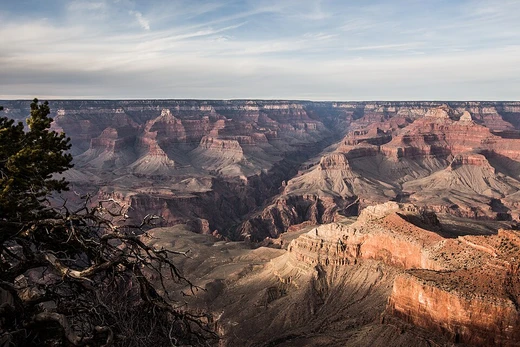
Granite
A tough, massive rock used in construction throughout history.

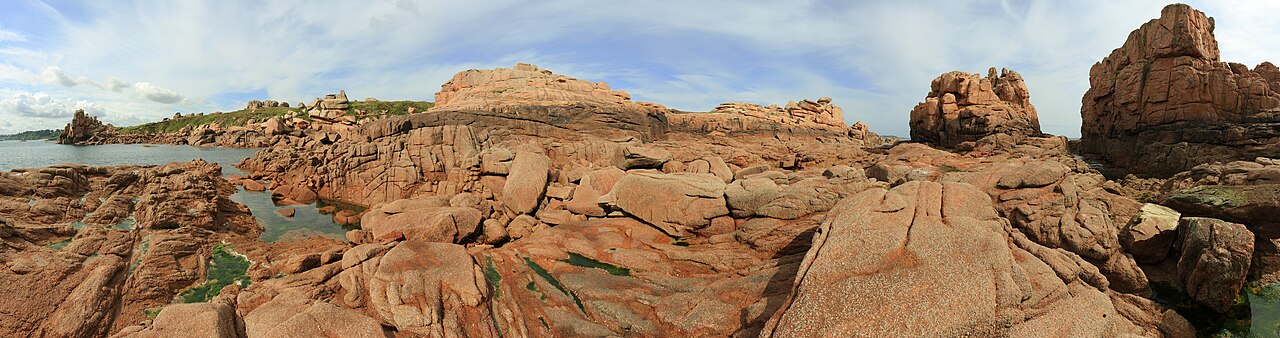
Giles Laurent · CC BY-SA 4.0
Granite is a coarse-grained (phaneritic) intrusive igneous rock composed mostly of quartz, alkali feldspar, and plagioclase, with mica as a common but not essential mafic mineral. It forms from magma with a high content of silica and alkali metal oxides that slowly cools and solidifies underground, and it is common in the continental crust of Earth, where it is found in igneous intrusions ranging from dikes to batholiths.
- type
- Igneous rock
- composition
- Quartz, alkali feldspar, mica, plagioclase
- average_density
- 2.65–2.75 g/cm³
- compressive_strength
- Usually above 200 MPa
- common_colors
- White, pink, gray
Lore & Background
The word 'granite' comes from the Latin 'granum,' meaning a grain, in reference to its coarse-grained structure. Granites can be predominantly white, pink, or gray, depending on their mineralogy. According to the standard IUGS classification, the essential minerals in granite are quartz, alkali feldspar, and plagioclase; mica is a common but not required mafic mineral, while amphibole is not a defining or essential constituent. These minerals form an interlocking matrix. Occasionally, larger crystals (phenocrysts) are present, creating a porphyritic texture known as granite porphyry. Granitic rocks are classified using the QAPF diagram, with true granite containing 20% to 60% quartz of the QAPF modal composition (i.e., of the felsic minerals) and 90% to 100% of total feldspar being alkali feldspar.
Reader's Guide
Granite is typical of a larger family of granitic rocks, or granitoids, and is nearly always massive and tough, making it a widespread construction stone throughout human history. It is widely distributed throughout the continental crust, often forming tors, domes, or rounded massifs. Granite forms from silica-rich (felsic) magmas, thought to originate by addition of heat or water vapor to lower crustal rock, or from subducted sediments at convergent boundaries. The alphabet classification system divides granites into I-type (igneous source) and S-type (sedimentary sources), based on their parental rock. Granite has poor primary permeability but strong secondary permeability through cracks. Its average density is between 2.65 and 2.75 g/cm³, and its compressive strength usually lies above 200 MPa.
Did You Know?
- Rhyolite is the extrusive equivalent of granite.
- The medium-grained equivalent of granite is microgranite.
- Granite often occurs as small stocks or in batholiths associated with orogenic mountain ranges.
- Two-mica granites are typically peraluminous, high in aluminum, and often contain both muscovite and biotite.
Formation from Deep-Earth Magmas
Granite does not erupt at the surface the way basalt does. Instead, it crystallizes deep underground from silica-rich, felsic magmas that cool and solidify over enormous spans of time. The parent magma is thought to originate not from the decompression of mantle material, as with basaltic melts, but from the heating or hydration of existing lower-crust rock. In certain tectonic settings, particularly along convergent plate boundaries where oceanic crust dives beneath continental crust, some granites appear to derive from sediments that were dragged down with the subducting slab. Because the magma cools so slowly beneath the surface, its mineral grains grow large enough to be seen with the naked eye, producing the characteristic coarse, phaneritic texture that gives the rock its name from the Latin granum, meaning grain. The resulting intrusions can be remarkably small, mere centimeter-wide dikes, or vast batholiths stretching across hundreds of square kilometers.
A Family of Rocks: Classification and Mineralogy
Granite sits within a broader family of coarse-grained, quartz- and feldspar-rich igneous rocks collectively called granitoids. Petrologists sort these rocks using the QAPF diagram, which assigns names based on the relative volumes of quartz, alkali feldspar, and plagioclase. True granite, by modern convention, contains between twenty and sixty percent quartz by volume, with thirty-five to ninety percent of its total feldspar being alkali feldspar—typically orthoclase or microcline, often displaying a perthitic intergrowth. The plagioclase component is usually the sodium-rich variety oligoclase. Within true granites, those with sixty-five to ninety percent alkali feldspar are termed syenogranites, while those with thirty-five to sixty-five percent are monzogranites. Granites hosting both muscovite and biotite micas earn the label binary or two-mica granite and tend to be potassium-rich and plagioclase-poor. At the other extreme, leucogranites contain almost no dark minerals at all. Rocks falling outside the true granite field are reclassified as syenites, monzonites, granodiorites, or tonalites depending on their mineral balance.
Physical Character and Behavior
Granite is a massive, structurally homogeneous rock—lacking foliation, bedding, or any other internal fabric—and is notably tough. Its interlocking, roughly equigranular matrix of feldspar and quartz, peppered with scattered biotite mica and amphibole crystals such as hornblende, gives it a dense, hard texture. Average density falls between 2.65 and 2.75 grams per cubic centimeter, and compressive strength typically exceeds 200 megapascals. At standard temperature and pressure, its melt viscosity is extraordinarily high, on the order of 3 to 6 times 10 to the 20th power pascal-seconds. Dry granite at ambient pressure does not melt until temperatures reach roughly 1,215 to 1,260 degrees Celsius, yet the presence of water can depress that threshold dramatically, allowing melting at as low as 650 degrees Celsius under several hundred megapascals of pressure. In terms of fluid flow, granite exhibits poor primary permeability, but where cracks and fractures develop, secondary permeability can become substantial. Color varies with mineralogy, and outcrops may appear predominantly white, pink, or gray.
Where Granite Lives in the Earth
Granite is the most abundant basement rock underpinning the continents, with much of it intruded during the Precambrian eon, long before the thin sedimentary veneer that now covers most land surfaces. Outcrops of this rock characteristically form tors, domes, bornhardts, and rounded massifs, and in some locations they appear as circular depressions ringed by hills created by the surrounding metamorphic aureole, or hornfels. Granitic bodies range from small stock masses covering less than one hundred square kilometers to enormous batholiths frequently associated with orogenic mountain-building events. At the margins of larger intrusions, narrow dikes of granitic composition known as aplites are commonly found, and in certain settings very coarse-grained pegmatite masses accompany the granite. The medium-grained counterpart of granite is called microgranite, while its extrusive, volcanic equivalent is rhyolite. Because of its toughness and massive character, granite has served as a widespread construction stone throughout human history.
Gallery

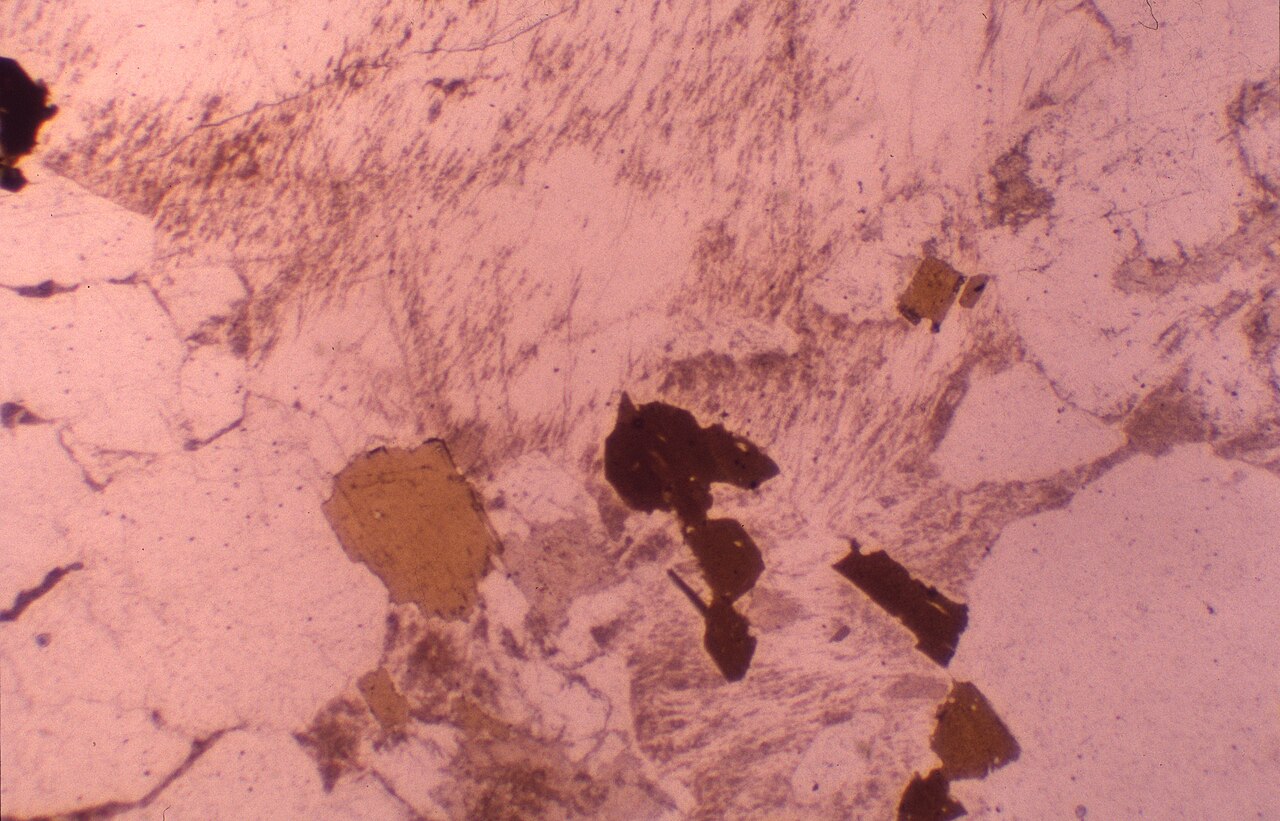
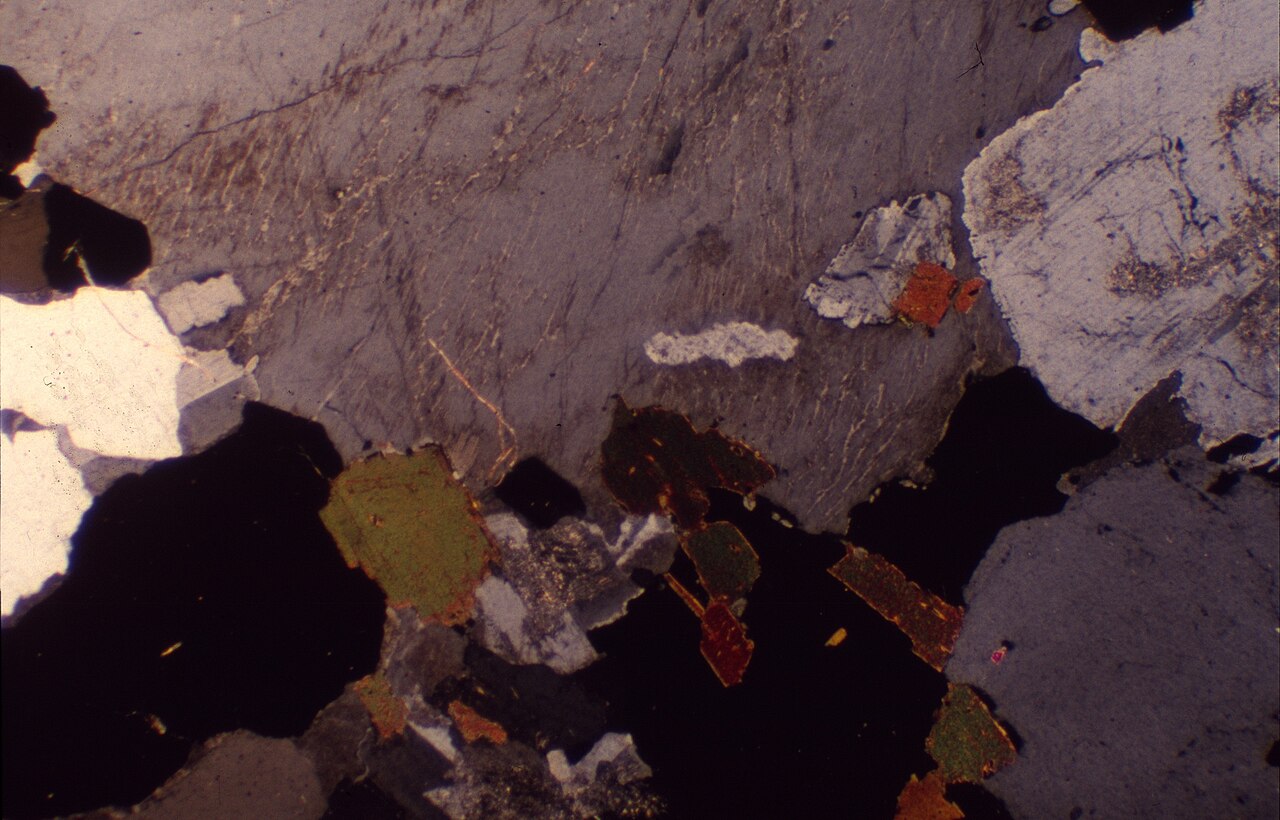
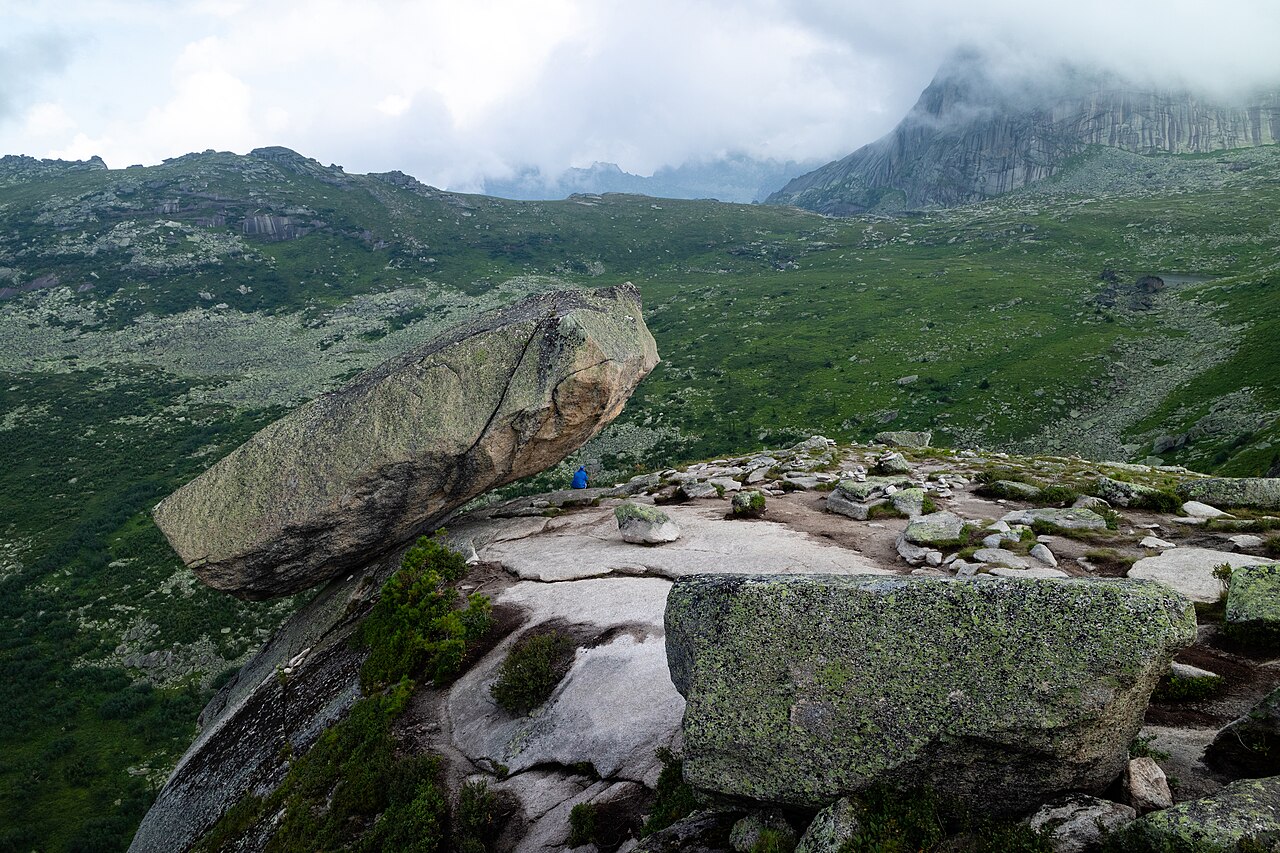

Frequently Asked Questions
What is Granite?
Granite is a coarse-grained intrusive igneous rock that crystallizes slowly deep beneath the Earth's surface. It is one of the most abundant rock types in the continental crust and typically appears in shades of white, pink, or gray.
What minerals make up Granite?
The primary mineral components are quartz, alkali feldspar, and plagioclase feldspar, with mica serving as a common but not strictly required mafic addition. This combination gives Granite its characteristic interlocking crystal texture.
How does Granite form?
It develops when silica- and alkali-rich magma cools and solidifies very slowly underground, allowing large crystals to grow. That slow cooling is what produces the coarse-grained phaneritic texture that sets it apart from finer-grained volcanic rocks.
Why is Granite so strong and durable?
Its compressive strength typically exceeds 200 MPa and its density sits around 2.65–2.75 g/cm³, making it exceptionally resistant to weathering and mechanical stress. These properties are why it has served as a go-to building material from ancient monuments to modern countertops.
Elsewhere in the Geology universe
Spotted an error? Know more?
This is a living reference — every entry is fact-audited, and reader corrections feed straight into our audit queue. Suggest an edit · See this site's audit record