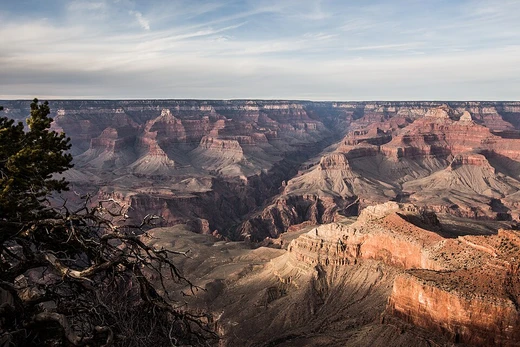
Earth's crust
Earth's outermost solid shell, making up about 1.25% of the planet's radius.

User:Zakapedia · CC BY-SA 3.0
Earth's crust is the planet's thin outer shell of rock, making up roughly 1.25% of Earth's radius and a tiny fraction of its volume. It is the top component of the lithosphere, a solidified division of Earth's layers that includes the crust and the upper part of the mantle. The lithosphere is broken into tectonic plates whose motion allows heat to escape the interior of Earth into space.
- thickness_continental
- 25–70 km (about 15–44 mi), locally up to 80 km (50 mi)
- average_density_continental
- 2.7–2.8 g/cm³
Lore & Background
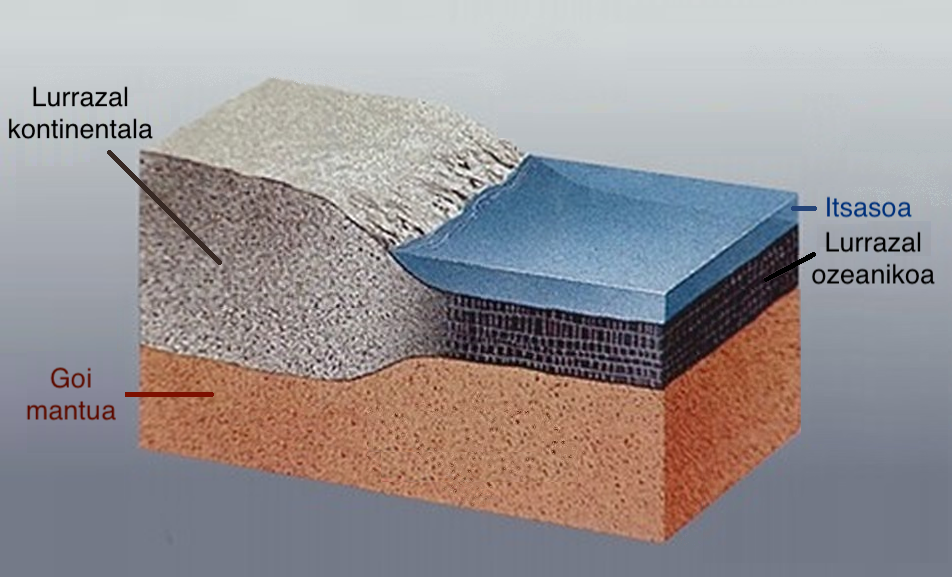
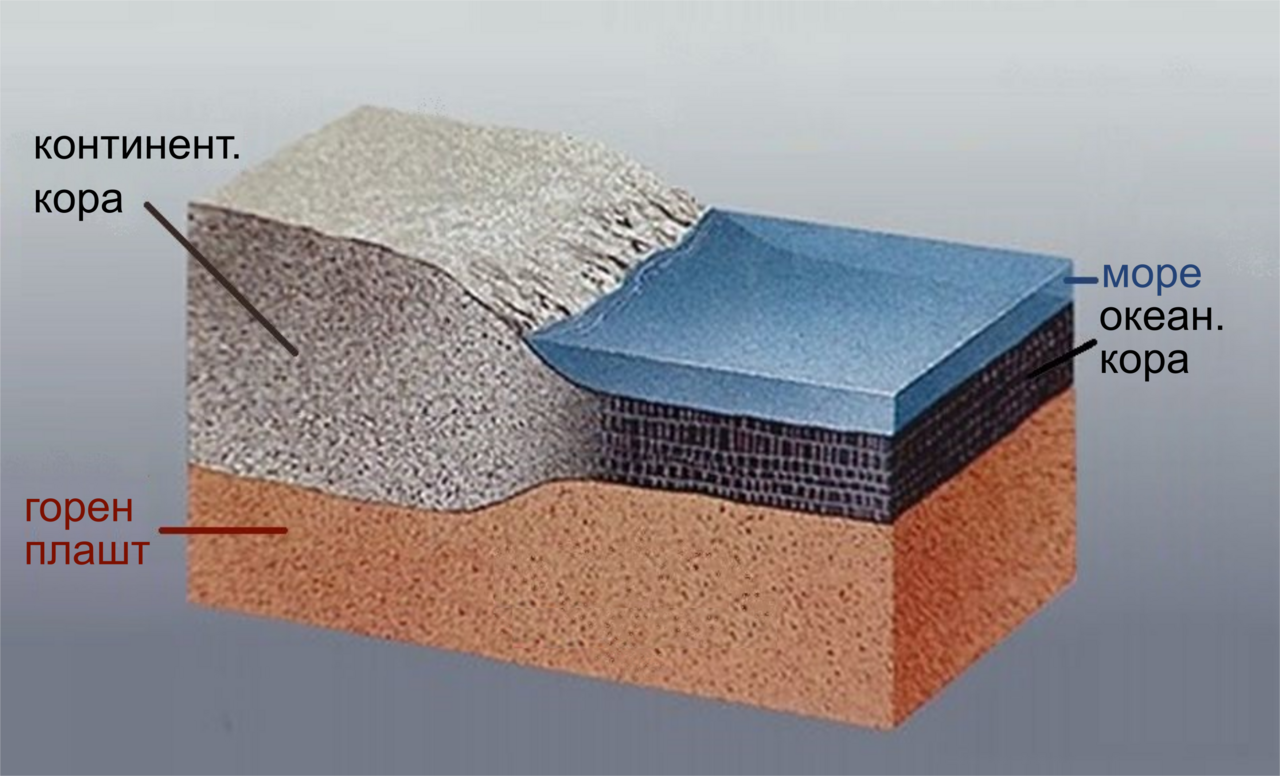
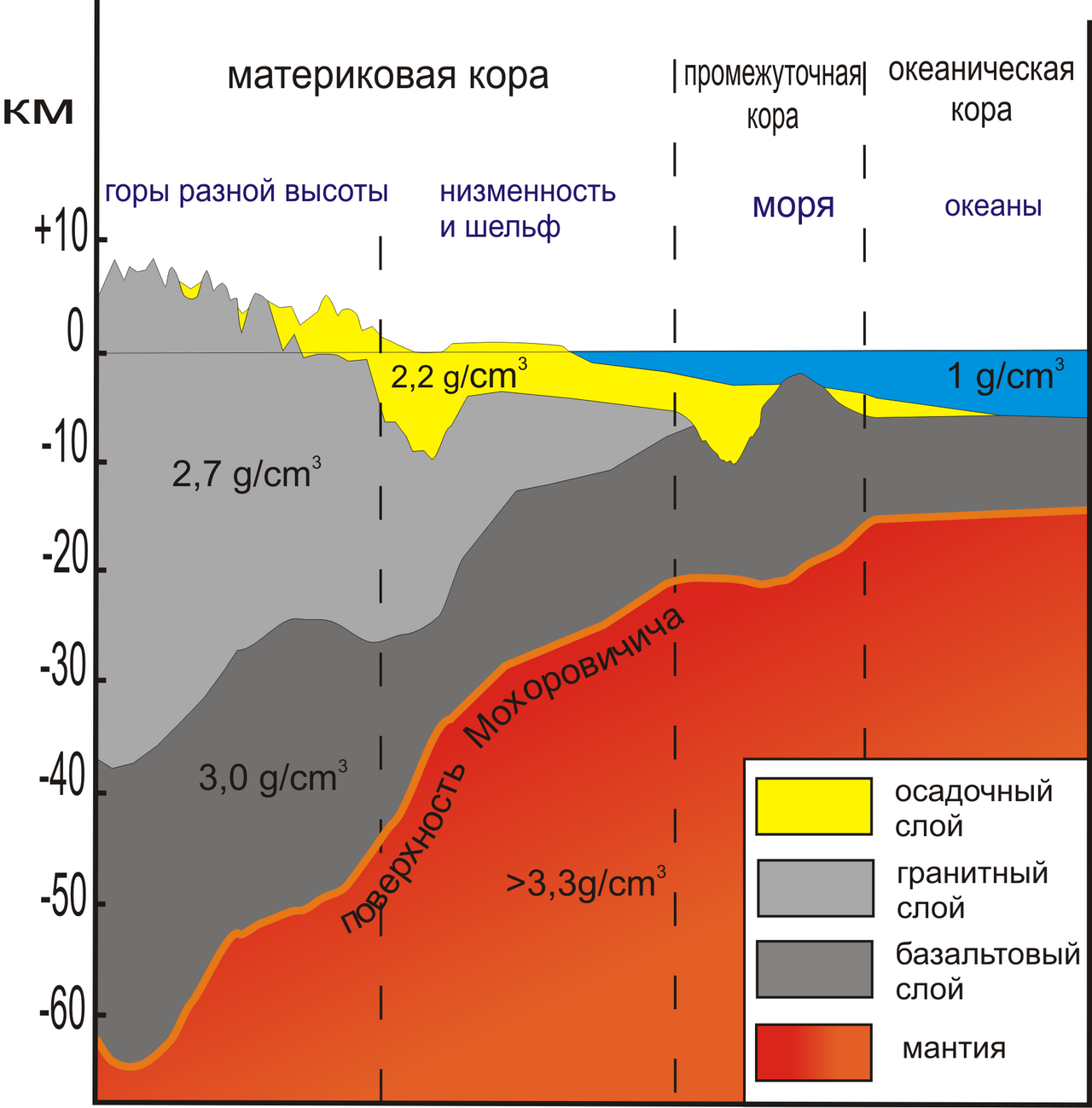
Earth's crust is divided into two distinct types: continental and oceanic. Continental crust is 25–70 km thick, composed mostly of less dense, felsic rocks such as granite, and has an average density of about 2.7–2.8 g/cm³. Oceanic crust is 5–10 km thick, composed primarily of denser, mafic rocks such as basalt, diabase, and gabbro. Both types are in isostatic equilibrium with the mantle, as they are less dense than the underlying peridotite. The boundary between crust and mantle is defined by the Mohorovičić discontinuity, a contrast in seismic velocity.
Reader's Guide
Earth's crust is significant as the outermost layer of the planet, hosting all known life and geological activity. It is composed of two types: continental crust, which forms high ground and is older, and oceanic crust, which is younger and constantly recycled through plate tectonics. The oldest continental crustal rocks date to about 3.7 to 4.28 billion years, found in the Narryer Gneiss terrane in Western Australia, the Acasta Gneiss in the Northwest Territories on the Canadian Shield, and other cratonic regions. Oceanic crust is no older than about 200 million years due to continuous creation at mid-ocean spreading centers and destruction at subduction zones. The crust's composition—dominated by feldspars (41%), quartz (12%), and pyroxenes (11%)—and its enrichment in incompatible elements relative to the mantle provide insights into Earth's differentiation and evolution. The crust's motion on continents can cause earthquakes, while movement under the seabed can lead to tidal waves.
Did You Know?
- The crust makes up about 1.25% of Earth's radius, not less than one percent.
- The most abundant minerals in the continental crust are feldspars, making up about 41% by mass.
- The oldest ocean crust on Earth today is only about 200 million years old.
Structure and Place in Earth's Architecture
The crust is the outermost rocky shell of our planet, accounting for less than one percent of Earth's total radius and volume. It sits as the uppermost component of the lithosphere, a solidified division that also encompasses the upper portion of the mantle. This lithosphere is fractured into tectonic plates, and the movement of those plates serves as the mechanism by which Earth's internal heat escapes into space. The crust rests atop the mantle in a configuration that remains gravitationally stable because the upper mantle, composed of peridotite, is substantially denser than the crustal material above it. The dividing line between these two layers is conventionally marked at the Mohorovičić discontinuity, a boundary identified not by a change in rock type but by a measurable contrast in how seismic waves travel through the material. This seismic-velocity signature is what allows geologists to map the boundary even though it lies far beyond the reach of any drill.
Two Faces of the Crust
Earth's crust is not a single uniform layer but comes in two fundamentally different flavors. Continental crust ranges from 25 to 70 kilometers thick, with exceptional thicknesses of 50 to 80 kilometers beneath the Tibetan Plateau, the Altiplano, and the eastern Baltic Shield. It is built primarily from less dense, more felsic rocks like granite, and its average composition resembles andesite, with the upper portion trending toward dacite and the lower portion toward basalt. Oceanic crust, by contrast, is a mere 5 to 10 kilometers thick and is dominated by denser, more mafic materials such as basalt, diabase, and gabbro. Because both crustal types are less dense than the peridotite mantle beneath them, they effectively float. The thicker, lighter continental crust rides higher, producing the continents that rise above sea level, while the thinner oceanic crust forms the deep basins below—a phenomenon known as isostasy. The average crustal thickness across the whole planet falls in the 15 to 20 kilometer range.
A Story Written in Deep Time
Earth assembled 4.6 billion years ago through the accretion of planetesimals and smaller rocky bodies orbiting the young Sun. That violent assembly melted the proto-planet entirely, and as it cooled, a primary or primordial crust first appeared. Yet none of that original material survives; it was obliterated by repeated large impacts, erosion, and the later onset of plate tectonics. The crust we see today is a secondary and tertiary product. Oceanic crust is born at mid-ocean spreading centers, where partial melting of the mantle generates basaltic magma that solidifies into new seafloor. This ridge push drives plate motion, and because new crust is constantly created, old crust must be consumed at subduction zones, meaning the oldest oceanic crust is only about 200 million years old. Continental crust, however, is far older, with the oldest known rocks dating to 3.7 to 4.28 billion years in the Narryer Gneiss terrane of Western Australia, the Acasta Gneiss in Canada's Northwest Territories, and the Fennoscandian Shield. Some zircon crystals from the Narryer terrane push as far back as 4.3 billion years. The average age of current continental crust is about 2 billion years, with most rocks older than 2.5 billion years residing in cratons.
Heat, Minerals, and Chemical Fingerprint
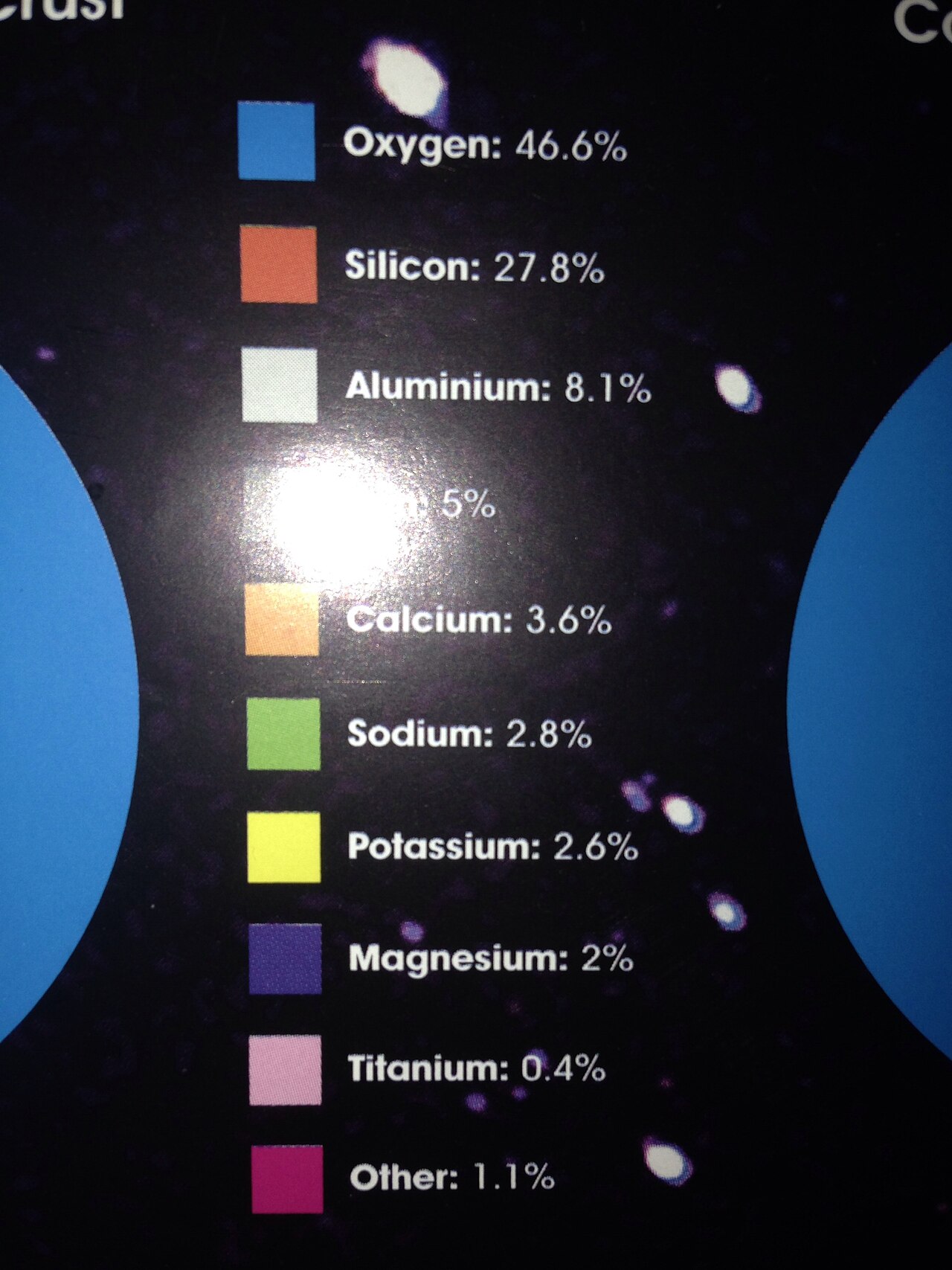
Temperature within the crust climbs steadily with depth, rising by as much as 30 degrees Celsius per kilometer in the upper crust and reaching between 700 and 1,600 degrees Celsius at the base where it meets the mantle. The mineral makeup of continental crust is dominated by feldspars, which account for roughly 41 percent of its mass, followed by quartz at 12 percent and pyroxenes at 11 percent. All other constituents, aside from water, are present in trace amounts totaling less than one percent. The average density of continental crust is about 2.835 grams per cubic centimeter, increasing from 2.66 in the uppermost layers to 3.1 at the base. Chemically, continental crust is notably enriched in incompatible elements compared to both oceanic crust and the underlying mantle. The most incompatible elements are concentrated by a factor of 50 to 100 relative to primitive mantle rock, whereas oceanic crust shows enrichment of only about a factor of 10. Oceanic crust, meanwhile, is structured as pillow lava and sheeted dikes of mid-ocean ridge basalt composition, capped by a thin sediment layer and underlain by gabbro.
Gallery
Frequently Asked Questions
Who is Earth's crust?
Earth's crust is the planet's outermost solid shell of rock, accounting for roughly 1.25% of Earth's total radius. It serves as the topmost component of the lithosphere, sitting directly above the upper mantle.
What are Earth's crust's powers or role?
The crust is shattered into tectonic plates whose slow drift channels internal heat out into space, acting as the planet's primary thermal regulator. Continental crust stretches from about 25 to 70 km thick and carries an average density near 2.7–2.8 g/cm³.
How does Earth's crust's story end?
No single slab of crust survives forever; at subduction zones it is dragged back into the mantle and melted, only to be reborn as new crust at divergent boundaries. This endless recycling loop means the crust as a layer persists for billions of years even as individual pieces are constantly replaced.
Why is Earth's crust important?
It is the sole solid surface the planet offers, providing stable ground for every ecosystem, ocean basin, and human settlement. Without this thin rocky skin, there would be no fixed stage on which life or civilization could exist.
How thin is Earth's crust relative to the whole planet?
Even at its thickest continental stretches of around 80 km, the crust is a vanishingly small fraction of Earth's radius and an even tinier slice of its total volume. Think of it as a paper-thin skin wrapped around a basketball-sized body of mantle and core.
More in Geology 1-24
Elsewhere in the Geology universe
Spotted an error? Know more?
This is a living reference — every entry is fact-audited, and reader corrections feed straight into our audit queue. Suggest an edit · See this site's audit record