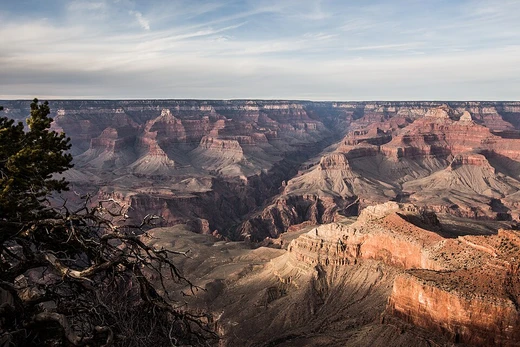
Cretaceous–Paleogene extinction event
Mass extinction that ended the age of non-avian dinosaurs.

Wilson44691 · CC0
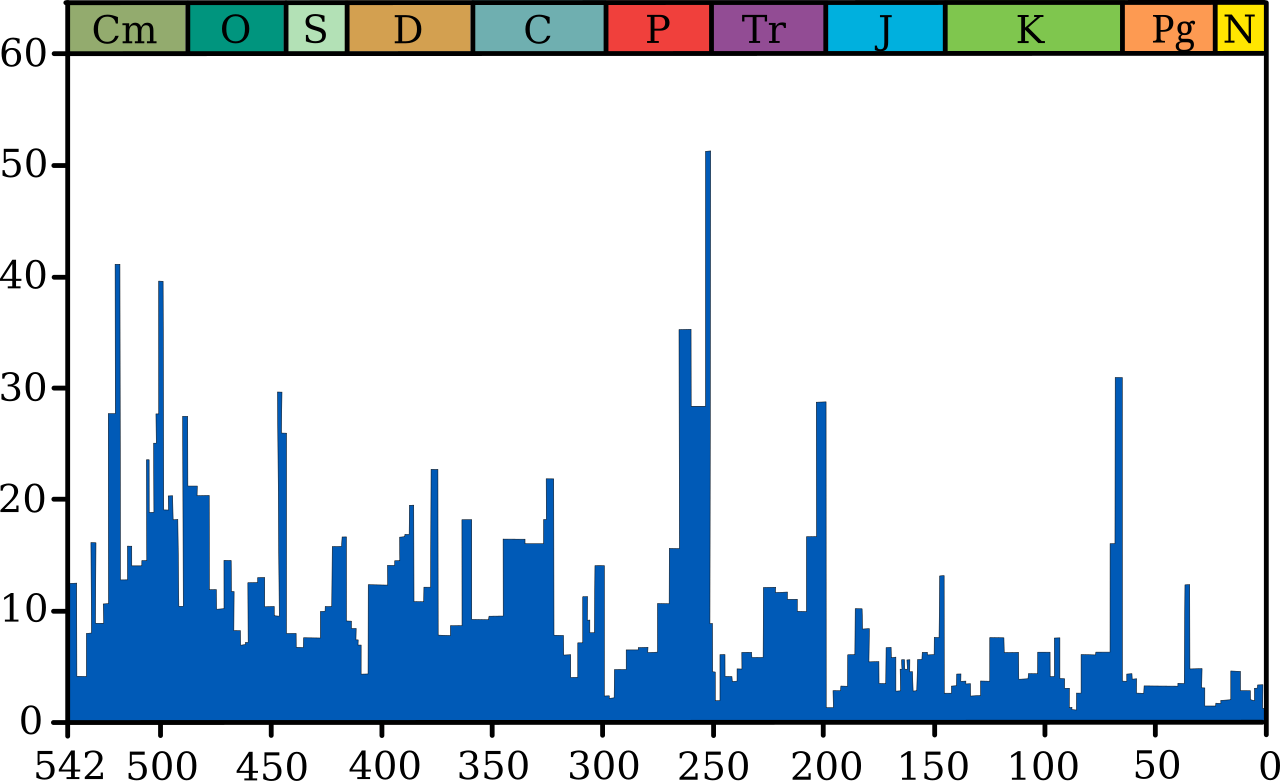
The Cretaceous–Paleogene (K–Pg) extinction event, formerly known as the Cretaceous–Tertiary (K–T) extinction event, was a major mass extinction that occurred around 66 million years ago, eliminating approximately 75% of plant and animal species on Earth. It marked the end of the Cretaceous period and the Mesozoic era, and the beginning of the Cenozoic era, and is best known for causing the extinction of all non-avian dinosaurs.
- type
- Mass extinction event
- time
- Around 66 million years ago
- species_lost
- Approximately 75% of plant and animal species
- primary_cause
- Impact of a massive asteroid 10–15 km wide
- impact_site
- Chicxulub crater, Yucatán Peninsula, Gulf of Mexico
- key_marker
- K–Pg boundary layer with high iridium levels
- survivors
- Avian dinosaurs (birds), some ectothermic tetrapods, and various small mammals and reptiles
Lore & Background
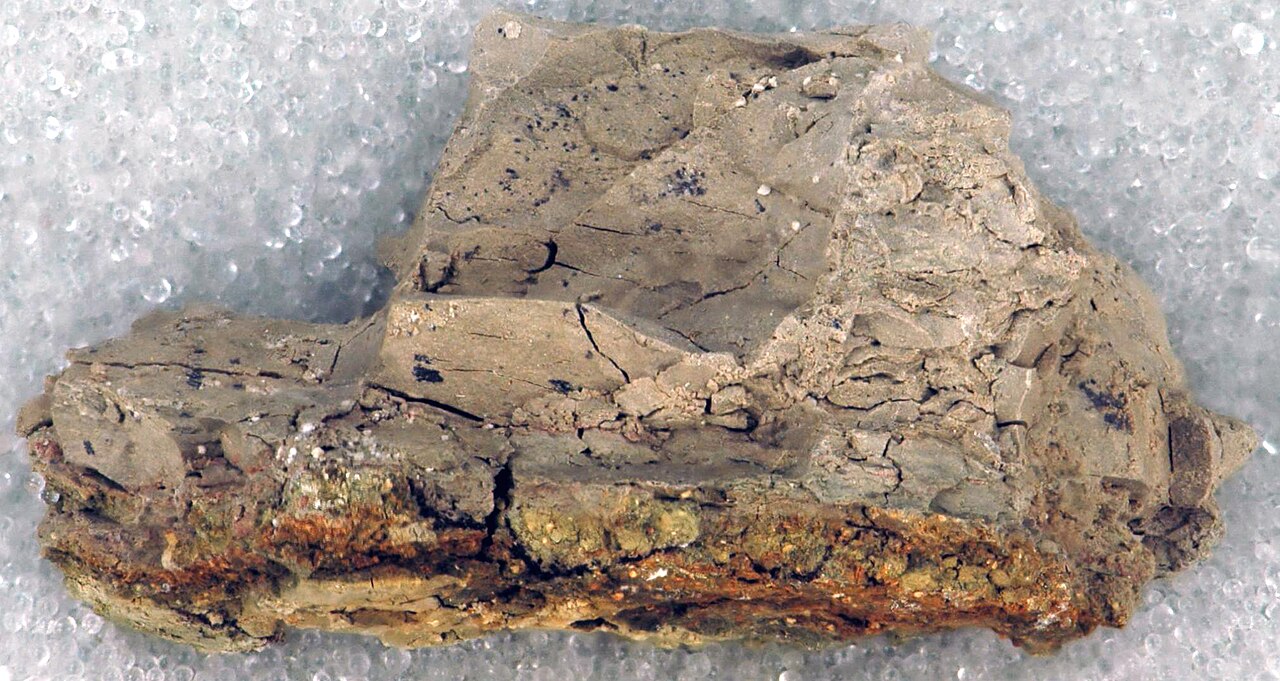
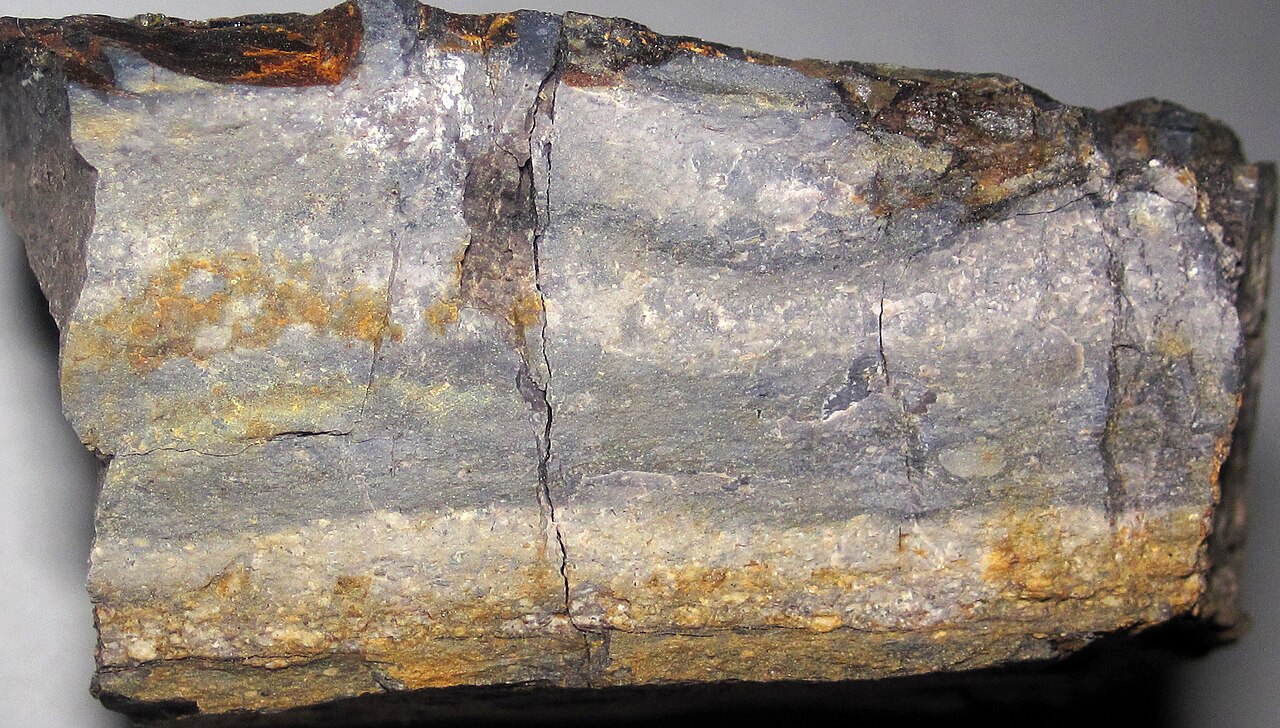
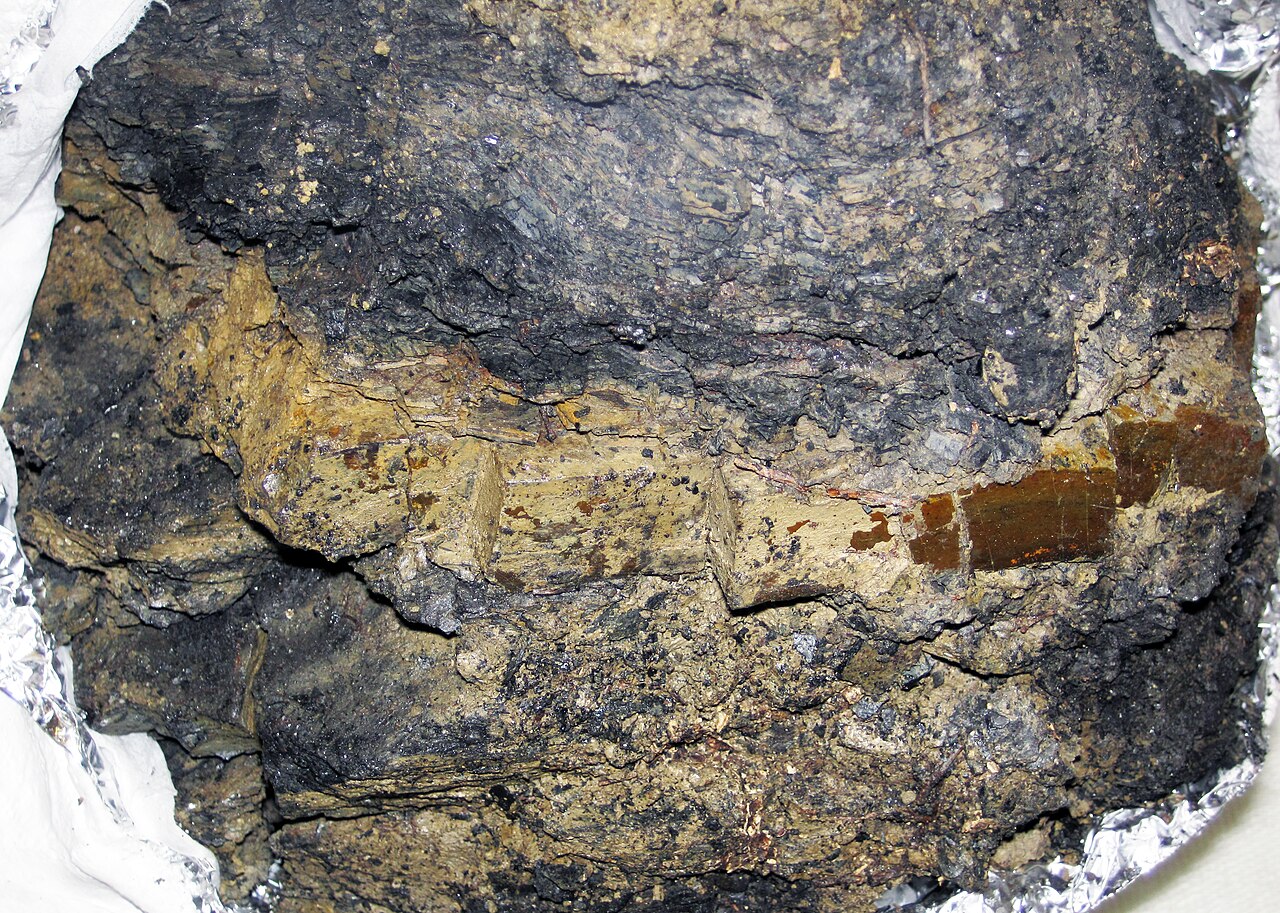
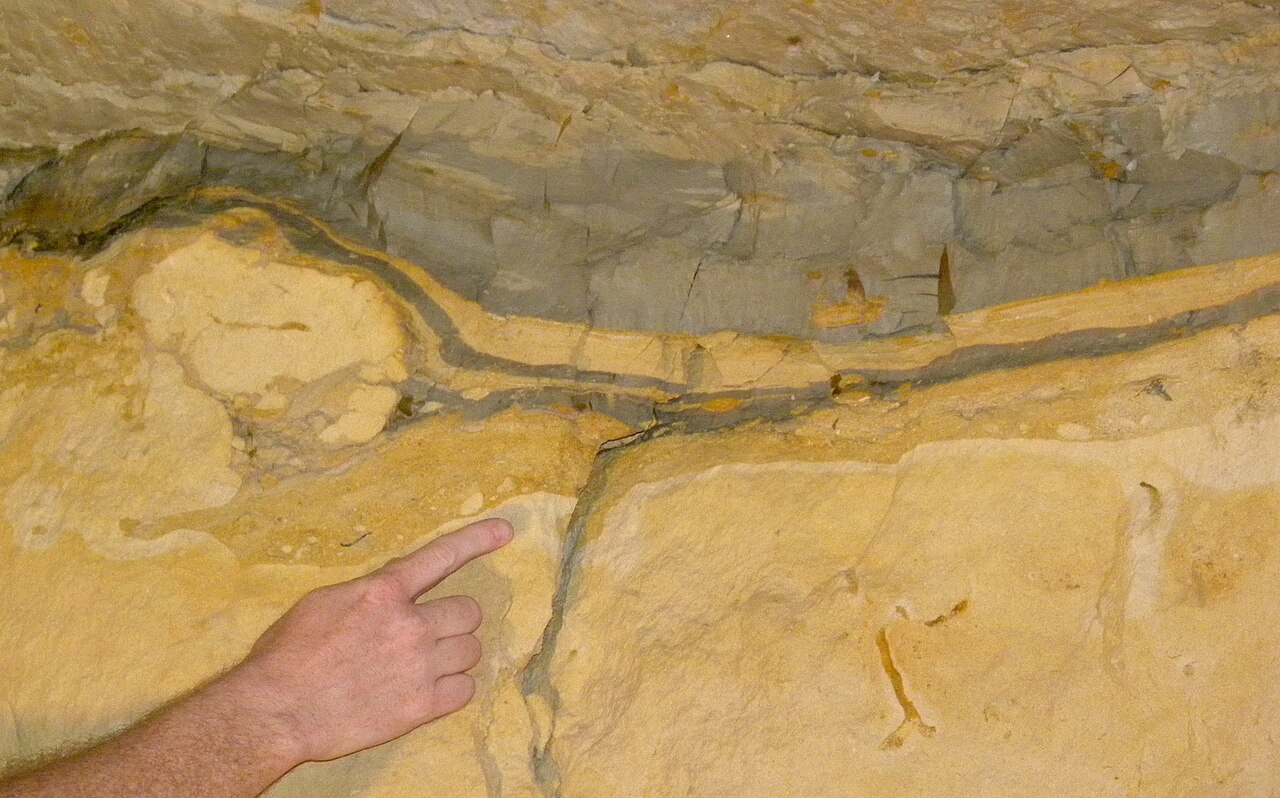
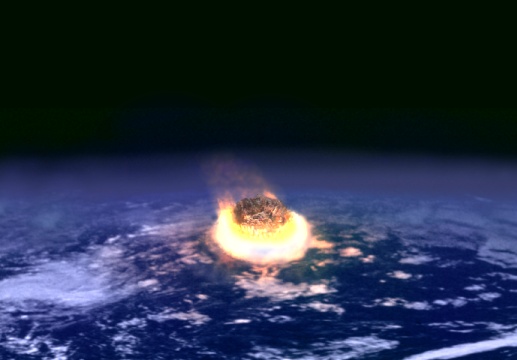
The K–Pg extinction event is marked in the geologic record by a thin layer of sediment called the K–Pg boundary, found worldwide, which contains unusually high levels of iridium—an element more common in asteroids than in Earth's crust. The leading hypothesis, known as the Alvarez hypothesis, attributes the extinction to the impact of a massive asteroid 10 to 15 km wide, which created the 180 km Chicxulub crater in the Gulf of Mexico's Yucatán Peninsula.
Reader's Guide
The K–Pg extinction event was a global, rapid, and selective catastrophe that reshaped life on Earth. It eliminated all non-avian dinosaurs, pterosaurs, plesiosaurs, mosasaurs, ammonites, rudists, and many species of plankton, while severely impacting teleost fish, sharks, and mollusks. The extinction was driven primarily by an asteroid impact that triggered an impact winter, blocking sunlight and halting photosynthesis, which devastated plant and plankton communities. This collapse of primary production cascaded through food webs, with species that depended on photosynthesis suffering the most. Omnivores, insectivores, and carrion-eaters fared better, as did organisms in stream and lake ecosystems that relied on detritus. The event also created evolutionary opportunities: mammals diversified rapidly in the Paleogene, giving rise to horses, whales, bats, and primates; surviving avian dinosaurs radiated into all modern bird species; and teleost fish and lizards also underwent adaptive radiation. Recovery of biodiversity took substantial time, with evidence suggesting faster recovery in the Southern Hemisphere than in the Northern Hemisphere. The extinction's selectivity and global impact make it a pivotal event in Earth's history, demonstrating how a single catastrophic event can permanently alter the course of evolution.
Did You Know?
- The K–Pg boundary clay contains unusually high levels of iridium, which is more common in asteroids than in Earth's crust.
- The Chicxulub impact crater is 180 km wide and located in the Gulf of Mexico's Yucatán Peninsula.
- Surviving mammals and birds after the extinction fed on insects, worms, and snails that fed on detritus.
From Curiosity to Complacency: The Nonquestion Phase
From the 1820s onward, naturalists noticed something striking at the boundary between the Mesozoic and Cenozoic eras. Georges Cuvier, in 1825, observed that the dominant lifeforms of the older era were largely marine and attributed their disappearance to a catastrophic sea-level drop, concluding that Cenozoic mammals were Earth's first genuinely land-dwelling fauna. Gideon Mantell, a few years later, framed the Mesozoic as the 'Age of Reptiles' in contrast to the Cenozoic 'Age of Mammals,' sharpening the perceived divide between the two. Yet despite these early observations, the sheer scarcity of known dinosaur fossils meant that the magnitude of their vanishing went largely unexamined. When Richard Owen in 1842 blamed rising atmospheric oxygen, and when Darwin in 1854 noted the ammonite extinction as 'wonderfully sudden' while still favoring gradual loss elsewhere, the scientific community lacked both the fossil record and the conceptual tools to take the event seriously. By the 1880s and 1890s, figures like Marsh and Woodward simply assumed dinosaurs had slowly declined. Paleontologist Michael J. Benton later labeled this entire stretch the 'Nonquestion Phase,' a period in which the extinction was acknowledged but never truly interrogated.
The Dilettante Phase: Senility, Superiority, and Speculation
Between roughly 1920 and 1970, explanations for the dinosaur extinction wandered through a landscape of unfounded assumptions. The idea that evolutionary lineages possessed finite lifespans—aging and deteriorating much like individual organisms—gained traction in the late nineteenth century and persisted well into the twentieth. In 1905, Frederic Brewster Loomis pointed to the ornamental plates of stegosaurs as maladaptive burdens that signaled impending doom, and in 1910 Arthur Smith Woodward declared the cause to be 'racial senility,' arguing that traits such as enormous body size, spiny armor, and toothlessness marked a group in its twilight. Franz Nopcsa in 1917 proposed that overactive pituitary glands had driven dinosaurs to pathological gigantism, drawing a parallel to human acromegaly. After the Neo-Darwinian synthesis displaced these pre-ordained-pattern theories, paleontologists turned to environmental explanations—mountain-building, cooling climates, volcanic eruptions—but much of the work in this era lacked rigor, solid evidence, or careful reasoning. Benton dubbed this the 'Dilettante Phase,' a half-century in which the extinction was discussed more as a curiosity than as a problem demanding systematic investigation.
The Iridium Anomaly and the Birth of a Controversy
Starting in 1970, paleontologists began approaching the K–Pg extinction with the kind of detailed, rigorous methodology that had been absent for decades. Early in what Benton termed the 'Professional Phase,' two questions dominated: how rapidly the extinctions had unfolded, and whether the Deccan Traps volcanic province in India played a causal role. Then, in 1980, father-and-son team Luis and Walter Alvarez published a finding that changed the trajectory of the entire field. They reported anomalously high concentrations of iridium—a platinum-group metal exceedingly rare in Earth's crust—at the K–Pg boundary layer. Their reasoning was straightforward: such an enrichment could not be explained by ordinary geological processes and demanded an extraterrestrial source, specifically an asteroid impact. The proposal ignited a bitter and prolonged controversy within the scientific community. Yet the evidence kept accumulating. Shocked quartz was identified at the boundary, and in 1991 Alan Hildebrand and William Boynton identified the Chicxulub structure in Mexico's Yucatan Peninsula as the probable impact site. Each new discovery chipped away at the resistance, gradually pulling the broader community toward the Alvarez hypothesis.
Consensus, the Chicxulub Crater, and a New Era
The decades of debate ultimately resolved into a clear scientific consensus. In 2010, an international panel of researchers convened to evaluate the competing hypotheses and concluded that an asteroid impact best explained the mass extinction at the end of the Cretaceous, and that the Chicxulub structure in the Yucatan Peninsula was indeed the resulting crater. Because the estimated timing of the impact aligns precisely with the K–Pg boundary, the scientific community now regards this single event as the direct cause of the death of most non-avian dinosaurs and countless other species. The crater itself measures just over 177 kilometers in diameter, making it the second-largest known impact structure on Earth. What began in the 1820s as a vague observation that something had changed between two geological eras, passed through a century of speculative dismissal and half-hearted investigation, and finally crystallized into a rigorously tested, evidence-based explanation. The Cretaceous–Paleogene extinction, once explained away as natural decline or mammalian superiority, now stands as a textbook case of how accumulated geological and geochemical evidence can overturn long-held assumptions and reshape our understanding of Earth's biological history.
Gallery
Frequently Asked Questions
Who is the Cretaceous–Paleogene extinction event?
It is the name geologists give to the mass-extinction episode that closed out the Mesozoic era roughly 66 million years ago. In plain terms, it wiped out roughly three-quarters of all plant and animal species, most famously every non-avian dinosaur.
What role does the K–Pg event play in Earth's story?
Think of it as the great turning point between the Age of Reptiles and the Age of Mammals. It draws the boundary line between the Cretaceous and Paleogene periods and resets the entire trajectory of life on the planet.
What caused the K–Pg event?
The leading explanation points to a colossal asteroid, roughly 10 to 15 kilometres across, striking the region that is now the Yucatán Peninsula in Mexico. The resulting impact, preserved as the Chicxulub crater, triggered global climate disruption that cascaded through food webs worldwide.
How do scientists identify the K–Pg event in the rock record?
Geologists look for a thin boundary layer of clay and sediment sitting between Cretaceous and Paleogene strata. That layer is enriched in iridium, a metal rare in Earth's crust but common in asteroids, which serves as a chemical fingerprint of the impact.
How does the K–Pg event's story end?
The extinction cleared vast ecological niches, allowing mammals, birds, and flowering plants to radiate into roles once dominated by dinosaurs. In that sense, the event's 'ending' is the dawn of the Cenozoic era and the world we recognise today.
More in Geology 1-24
Elsewhere in the Geology universe
Spotted an error? Know more?
This is a living reference — every entry is fact-audited, and reader corrections feed straight into our audit queue. Suggest an edit · See this site's audit record