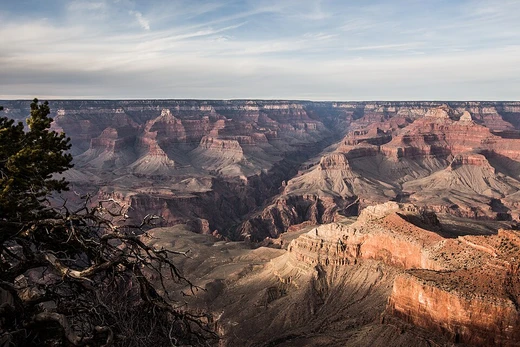
Earth's mantle
Silicate layer between crust and outer core, driving plate tectonics.

Earth's mantle is a layer of silicate rock between the crust and the outer core. It has a mass of 4.01×10^24 kg and makes up 86% of the mass of Earth. It is predominantly solid but, on geologic time scales, behaves as a viscous fluid, sometimes described as having the consistency of caramel. Partial melting of the mantle at mid-ocean ridges produces oceanic crust, and partial melting at subduction zones produces continental crust.
- mass
- 4.01×10^24 kg
- percentage_of_Earth_mass
- 86%
- percentage_of_Earth_radius
- 46%
- percentage_of_Earth_volume
- 84%
Lore & Background
The mantle is divided into three major layers defined by sudden changes in seismic velocity: the upper mantle (from the Moho to 410 km depth), the transition zone (410–660 km), and the lower mantle (660–2,891 km). The upper mantle is dominantly peridotite, composed of olivine, clinopyroxene, orthopyroxene, and an aluminous phase. At the top of the transition zone, olivine transforms to wadsleyite and ringwoodite, which can store water in their crystal structure. The lower mantle is composed primarily of bridgmanite and ferropericlase. The lower ~200 km of the lower mantle constitutes the D" region, with anomalous seismic properties.
Reader's Guide
The mantle is significant because it constitutes the bulk of Earth's volume and mass, and its convective circulation drives plate tectonics, volcanism, and the formation of oceanic and continental crust. The temperature difference between the Earth's surface and outer core, combined with the ability of crystalline rocks to undergo slow, viscous-like deformation over millions of years, creates a convective material circulation. Hot material rises in mantle plumes, while cooler material sinks at subduction zones. The mantle's composition has changed through Earth's history due to the extraction of magma that solidified to form crust. Seismic images have revealed two continent-sized anomalies in the lowermost mantle that may represent buried relics of Theia mantle material from the Moon-forming event. The mantle's behavior and structure are essential for understanding Earth's internal dynamics, the rock cycle, and the long-term evolution of the planet.
Did You Know?
- The mantle makes up 84% of Earth's volume and 86% of its mass.
- Partial melting of the mantle at mid-ocean ridges produces oceanic crust, and at subduction zones produces continental crust.
- The transition zone may host a large quantity of water due to high-pressure olivine polymorphs that can store water in their crystal structure.
- Seismic images have revealed two continent-sized anomalies in the lowermost mantle that may be buried relics of Theia mantle material from the Moon-forming event.
More in Geology 1-24
Elsewhere in the Geology universe
Spotted an error? Know more?
This is a living reference — every entry is fact-audited, and reader corrections feed straight into our audit queue. Suggest an edit · See this site's audit record