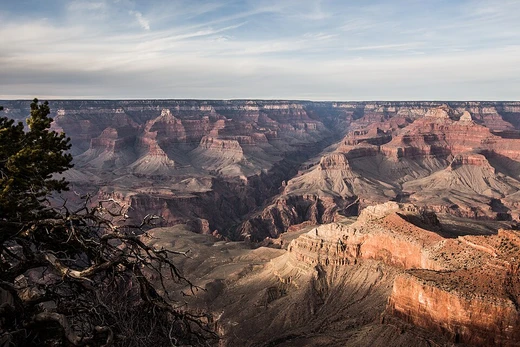
Geologic time scale
Standardized system dividing Earth's history into defined time intervals.

The geologic time scale is a system for dividing Earth's 4.54 ± 0.05 billion-year history into standardized intervals based on the rock record and principles of chronostratigraphy and geochronology. It is used primarily by Earth scientists to describe the timing and relationships of events in geologic history.
- field
- Earth science (geology, paleontology, geophysics, geochemistry, paleoclimatology)
- governing_body
- International Commission on Stratigraphy (ICS), a constituent body of the International Union of Geological Sciences (IUGS)
- time_span_covered
- about 4.54 ± 0.05 billion years
- largest_unit
- Eon (four formally defined: Hadean, Archean, Proterozoic, Phanerozoic)
- smallest_hierarchical_unit
- Age (96 formal and five informal ages; current age is the Meghalayan)
- current_epoch
- Holocene
- current_period
- Quaternary
Lore & Background
The geologic time scale arranges the rock record in chronological order by observing fundamental changes in stratigraphy that correspond to major geological or paleontological events. It combines chronostratigraphy, which studies rock sequences to determine relative ages, and geochronology, which uses quantitative measurements like radiometric dating to provide precise ages. Key principles include the law of superposition, original horizontality, lateral continuity, cross-cutting relationships, law of included fragments, unconformities, and faunal succession.
Reader's Guide
The geologic time scale is the foundational framework for understanding Earth's history, enabling scientists to correlate rock sequences globally and date events such as mass extinctions and mountain building. Its development is overseen by the International Commission on Stratigraphy, which defines global chronostratigraphic units on the International Chronostratigraphic Chart. Boundaries between units are often defined by Global Boundary Stratotype Section and Points (GSSPs), known informally as 'golden spikes,' which mark precise points in specific rock successions. For example, the iridium anomaly from the Chicxulub impact defines the boundary between the Cretaceous and Paleogene. The scale uses units such as eons, eras, periods, epochs, ages, and chrons, with numeric ages expressed in Ma (megaannum), Ga (gigaannum), or ka (kiloannum). While the scale is standardized internationally, regional terms persist in some areas, and absolute ages of boundaries can be refined by improved dating techniques without altering the rock-defined boundaries.
Did You Know?
- The geologic time scale covers a time span of about 4.54 ± 0.05 billion years.
- The International Commission on Stratigraphy (ICS) is responsible for defining standardized international units of geological time.
- A Global Boundary Stratotype Section and Point (GSSP) defines the lower boundary of a stage at a precise point in a specific rock succession.
- The current epoch is the Holocene, and the current age is the Meghalayan.
More in Geology 1-24
Elsewhere in the Geology universe
Spotted an error? Know more?
This is a living reference — every entry is fact-audited, and reader corrections feed straight into our audit queue. Suggest an edit · See this site's audit record